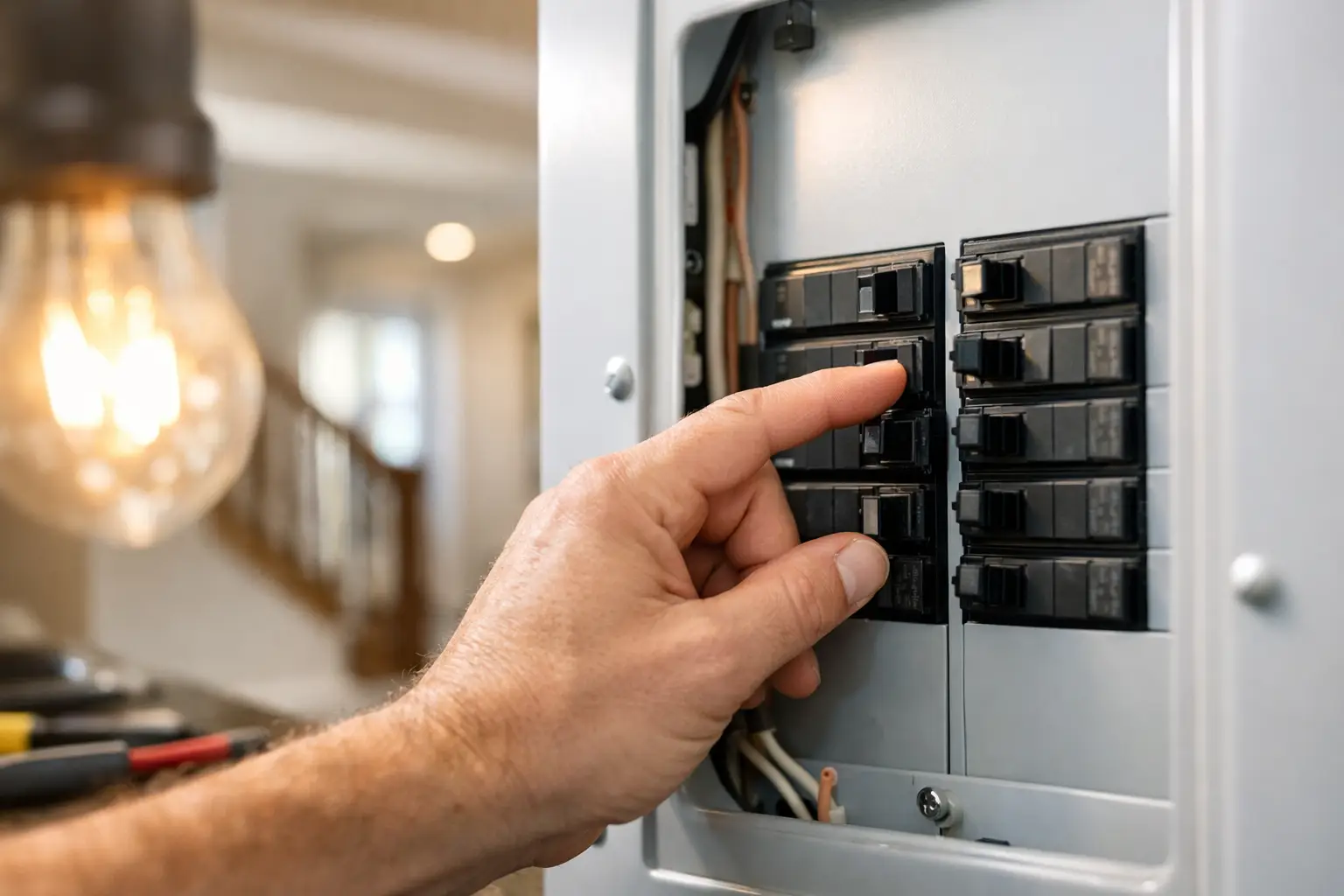
A circuit breaker that trips once may have done exactly what it was designed to do. A breaker that trips repeatedly is a warning that deserves attention, particularly if it affects essential equipment, lighting, refrigeration, machinery or safety systems. If you are asking, “why do breakers keep tripping?”, the answer is usually an overload, a faulty appliance, a wiring fault or an issue with the circuit protection itself.
The safe response is not to keep resetting it until it stays on. Identify what has changed, reduce the load where practical, and arrange a licensed electrician if the problem continues or there are signs of damage.
Why do breakers keep tripping?
A breaker protects cables and electrical equipment from excessive current. When the current exceeds the circuit’s safe rating, the breaker disconnects the supply before wiring can overheat. This can happen instantly in a short circuit or after a period of sustained load.
At many Victorian properties, people use the term “breaker” for any switch that has tripped in the switchboard. However, the device may be a circuit breaker, an RCD (residual current device), or a combined RCBO. The distinction matters. A circuit breaker typically responds to overloads and short circuits, while an RCD or RCBO can trip when it detects current leaking to earth, which may indicate an electric shock risk.
The position of the tripped switch, its labelling, and what was operating at the time all help narrow down the cause. A single power circuit that trips when the kettle and microwave run together points to a different problem from an RCD that trips every time an outdoor light is switched on.
Common causes of a tripping breaker
Too much demand on one circuit
Overloading is one of the most common causes in homes, offices and older commercial spaces. Every circuit has a limit. Plugging several high-demand appliances into outlets served by the same circuit can push it beyond that limit, even if each appliance works normally on its own.
In a home, this may be a toaster, kettle, coffee machine and air fryer operating on the same kitchen circuit. In a workshop or office, it could be heaters, printers, battery chargers, computers or portable air conditioners sharing a circuit intended for lighter use. Industrial sites may experience the same issue when additional equipment has been connected without reviewing the available circuit capacity.
The timing is useful here. If the breaker trips only when several appliances or pieces of equipment operate together, an overload is likely. Reducing the load may restore operation, but recurring overloads should be assessed. The long-term solution may involve redistributing loads, installing a dedicated circuit or upgrading part of the electrical installation after proper assessment.
A faulty appliance or piece of equipment
An appliance can develop an internal fault that causes a breaker or RCD to trip. Damaged heating elements, worn power leads, moisture ingress, deteriorated insulation and failed internal components are common causes.
A practical initial check is to switch off and unplug appliances on the affected circuit before resetting the breaker once. Reconnect and operate items one at a time. If the circuit trips when a particular appliance is plugged in or switched on, stop using that item and have it repaired, tested or replaced.
Do not continue testing equipment that is hot, smells burnt, has a damaged lead, produces sparks, shows scorch marks or has been exposed to water. In workplaces, faulty equipment should be removed from service and managed in line with site procedures.
A short circuit in wiring or equipment
A short circuit occurs when active and neutral conductors, or an active conductor and earth, come into unintended contact. It creates a sudden high current and generally trips the circuit breaker immediately.
Short circuits can result from damaged cables, loose connections, pest damage, nails or screws penetrating concealed wiring, failed outlets, damaged light fittings or faults inside connected equipment. Renovations and recent fit-outs are worth considering. A breaker that began tripping after shelves, cabinetry, signage or equipment was installed may be linked to disturbed or damaged wiring.
This is not a fault to investigate by opening outlets, fittings or the switchboard. Electrical work must be carried out by a licensed electrician. Attempting a repair without the right training and test equipment can create a serious shock, fire and compliance risk.
Earth leakage or moisture
If an RCD or RCBO keeps tripping, earth leakage is a likely possibility. These devices monitor the balance of current flowing through a circuit. If some current is escaping to earth, they disconnect the supply quickly to reduce the risk of electric shock.
Moisture is a frequent contributor, especially in bathrooms, laundries, kitchens, outdoor areas, plant rooms and older light fittings. Water in an external socket, condensation in equipment, a leaking appliance or a weather-damaged fitting can all cause intermittent tripping. The fault may appear only after rain, washing down an area, using a particular appliance or turning on outdoor lighting.
Because RCD tripping can indicate a safety issue, repeated resets are not appropriate. Leave the affected circuit off if it will not stay on after one careful reset with appliances disconnected, then arrange electrical fault finding.
A failing breaker, RCD or switchboard component
Protective devices do not last forever. Heat, age, frequent operation, loose terminations and previous faults can affect their reliability. A breaker that feels unusually hot, will not reset properly, trips with little or no connected load, or has visible discolouration needs prompt professional attention.
Older switchboards can also have limitations that become apparent as a property’s electrical demand grows. Modern households often have more appliances, chargers and climate-control equipment than the original installation was designed to support. Businesses may add technology, refrigeration, equipment or machinery over time without changes being made at the switchboard.
Replacing a breaker without diagnosing the underlying cause is not a reliable solution. A licensed electrician should test the circuit, connections, protective device and connected load before recommending repairs or upgrades.
Safe checks before you call an electrician
Start by looking at the switchboard labels and noting exactly what has tripped. Record whether it is a power circuit, lighting circuit, hot water circuit, air conditioning circuit or main safety switch. Then consider what was running immediately before the trip and whether the issue followed rain, cleaning, renovation work or installation of new equipment.
If there are no signs of damage, switch off or unplug appliances on the affected circuit. Reset the tripped device fully by moving it to the off position first, then back to on. If it holds, reconnect appliances one at a time. This can help identify an obvious faulty item without touching fixed wiring.
Stop and call a licensed electrician if the device trips again, if more than one circuit is affected, or if you cannot confidently isolate the source. Do not remove the switchboard cover, bypass a breaker, replace a protective device with a larger rating, or use power boards and extension leads as a permanent capacity solution.
When a tripping breaker needs urgent attention
Some situations should be treated as urgent rather than monitored. Turn off the affected circuit where safe to do so and seek professional help if you notice a burning smell, buzzing or crackling, heat at the switchboard, smoke, sparks, melted plastic, water near electrical equipment or repeated tripping with nothing plugged in.
The same applies where critical business or industrial equipment is affected. Refrigeration, emergency systems, medical equipment, security, production machinery and IT infrastructure may require a planned response that protects people and limits downtime. A qualified electrician can fault-find safely, identify whether the issue is localised or supply-related, and advise on repairs or circuit improvements.
Preventing repeat trips
Prevention starts with matching electrical capacity to how a property is actually used. Avoid loading one circuit with several high-current appliances, replace damaged leads promptly, keep outdoor fittings weatherproof and have electrical work completed properly when adding equipment or altering a space.
For commercial and industrial sites, maintain clear circuit schedules and review capacity before installing new plant, workstations or machinery. Testing and maintenance programs are also valuable where equipment operates continuously or conditions include dust, moisture, vibration or heat.
A tripping breaker is a protective device doing its job, not an inconvenience to work around. If the cause is not obvious after a safe basic check, iElectrify can assess the circuit and help restore dependable, compliant operation without guessing at the fault.