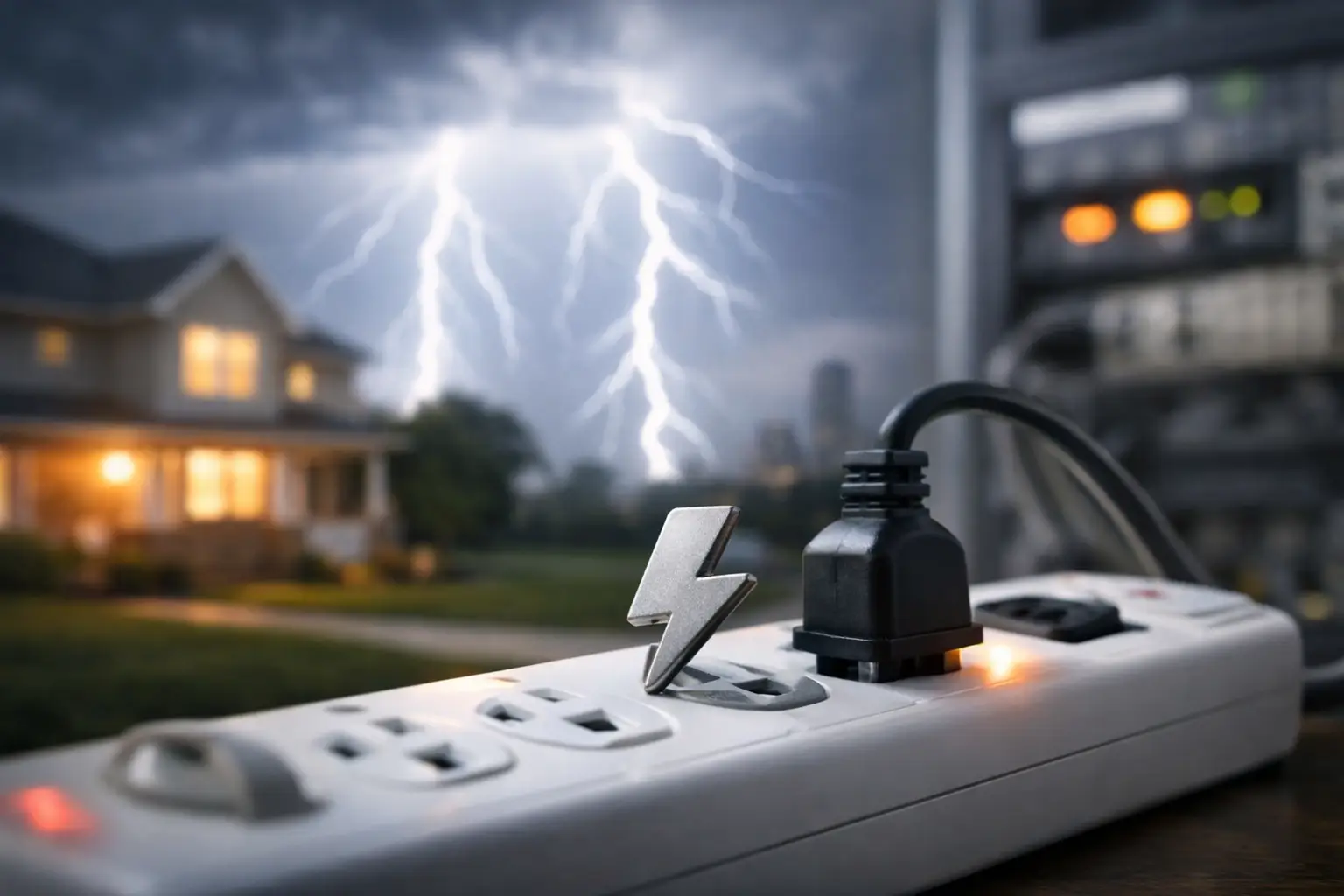
A lightning strike does not need to hit your building to damage electrical equipment. A nearby strike, a fault in the supply network or a switching event inside a larger site can send a short, high-voltage spike through connected wiring. The top benefits of surge protection come down to reducing the chance that this event turns into damaged appliances, interrupted operations or an expensive call-out.
For Melbourne homes, commercial premises and industrial facilities, electrical systems now carry far more sensitive equipment than they did a decade ago. Smart appliances, LED drivers, security systems, networking equipment, control gear and solar components can all be affected by voltage surges. Good surge protection is not a replacement for sound wiring, circuit protection or regular maintenance. It is another layer of protection, selected to suit the property and its electrical risks.
What a power surge can do
A surge is a brief increase in voltage above the level electrical equipment is designed to handle. It may last only microseconds, but that can be enough to degrade internal components or cause immediate failure. Large external events such as lightning are the most obvious source, yet many surges occur closer to home.
Motors, air conditioners, pumps, lifts and other inductive loads can create switching transients when they start or stop. Faults or switching activity in the electricity network may also affect a building. In commercial and industrial settings, frequent switching can create repeated low-level stress on connected equipment even where there is no dramatic, single incident.
The result is not always an appliance that stops working on the spot. Electronics can suffer cumulative damage. A controller may become unreliable, a network device may fail early, or a circuit board can develop an intermittent fault that is difficult to trace. This is why surge protection should be considered as part of asset protection, not only as a response after lightning damage.
Top benefits of surge protection for homes and businesses
Better protection for sensitive equipment
Modern equipment relies on compact electronic components that can be vulnerable to voltage spikes. At home, this may include televisions, computers, Wi-Fi equipment, smart home controls, ovens, air conditioning systems and solar inverters. In a business, the list often extends to point-of-sale systems, servers, CCTV, access control, medical or specialist equipment, refrigeration controls and communications hardware.
A correctly selected surge protective device helps divert excess voltage away from the installation and towards earth, limiting the voltage that reaches downstream circuits and connected equipment. It cannot promise that every item will survive every electrical event. However, it can substantially improve the protection available compared with relying on standard circuit breakers alone.
Circuit breakers and safety switches serve different jobs. A circuit breaker responds to overloads and short circuits, while a safety switch is designed to reduce the risk of electric shock from earth leakage. Neither is intended to provide complete protection from transient overvoltage.
Less downtime when systems matter
For a commercial operator, the cost of a damaged device is often more than its replacement price. If a surge takes out a modem, switch, EFTPOS terminal or refrigeration controller, work may stop until a replacement is sourced and installed. A short interruption can become lost sales, frustrated customers and staff time spent working around the problem.
In industrial environments, the consequences can be broader. A failed variable speed drive, PLC, monitoring device or control circuit can interrupt production, affect process quality and delay maintenance schedules. Sites with automated systems may have equipment that is expensive to replace and cannot simply be bought off the shelf.
Surge protection supports continuity by reducing the likelihood that a voltage event disables a critical part of the system. It should sit alongside sensible measures such as backups, uninterruptible power supplies where appropriate, documented shutdown procedures and planned electrical maintenance.
A practical way to protect high-value upgrades
Electrical upgrades are significant investments. A renovation may add a new switchboard, induction cooking, ducted heating and cooling, electric vehicle charging or rooftop solar. A business fit-out may include data cabling, security, lighting controls and specialised machinery. Protecting only the visible equipment while leaving the electrical system exposed to surges leaves a gap in the overall project.
Installing surge protection during switchboard work is often simpler and more cost-effective than returning later. It allows the electrician to assess the board layout, earthing arrangement, incoming supply and circuits that serve sensitive or essential equipment. For major sites, protection may be coordinated at more than one point in the installation rather than relying on one device alone.
That level of design matters. A device at the main switchboard can address surges entering through the supply, while local protection may still be warranted for particularly sensitive or remote equipment. The right approach depends on the building, the electrical distribution arrangement and the assets being protected.
Reduced risk of hidden equipment damage
A power surge can leave no obvious evidence. The lights may return, the appliance may restart and the building may appear normal. Yet the internal power supply or circuit board may have been weakened. Weeks later, the equipment fails and the original cause is no longer clear.
This makes surge-related faults frustrating for property owners and facility managers. Replacing individual devices one at a time is disruptive, especially when the affected equipment is part of a connected system. Preventative protection helps reduce this hidden exposure and can make long-term maintenance more predictable.
Support for insurance and risk management
Insurance is valuable after a loss, but it does not prevent operational disruption or restore data, stock and customer confidence immediately. Policies also have conditions, exclusions and excesses that need to be understood. For businesses and managed facilities, demonstrating that reasonable preventative measures have been considered can form part of a broader risk-management approach.
Surge protection will not remove every electrical risk, and it should not be treated as an insurance substitute. Its value is in reducing exposure before damage occurs. This is particularly relevant where a site has expensive electronics, a history of supply issues, overhead supply lines, frequent storms or equipment that is difficult to replace quickly.
Choosing the right level of protection
Not all surge protective devices are the same. Selection depends on the type of supply, whether the property has overhead or underground mains, the presence of lightning protection, the switchboard configuration, earthing conditions and the equipment in use. Residential properties may need a straightforward switchboard solution, while a warehouse, office complex or industrial site may require a coordinated system across main and sub-boards.
A plug-in surge-protected power board can offer an extra layer for selected electronics, but it is not a complete building-level strategy. Its performance can be limited by the installation, the quality of the device and the path a surge takes through the property. It also does not protect fixed-wired equipment in the same way as a professionally installed device at the switchboard.
For solar systems, electric vehicle chargers, communications lines and data infrastructure, the assessment may need to look beyond standard power circuits. Surges can enter through different pathways, including telecommunications and data cabling. Protection needs to be coordinated so one part of the system is not strengthened while another remains exposed.
Installation and maintenance should be handled properly
Surge protection is electrical work, not a DIY switchboard addition. In Victoria, work on fixed electrical installations must be carried out by a suitably qualified and licensed electrical professional. The device must be compatible with the installation, correctly connected and supported by an effective earthing system.
Maintenance also matters. Many devices have visual status indicators that show whether the protective components are still operational. After a known electrical event, during scheduled switchboard maintenance or when an indicator shows a fault, the device should be checked. A surge protective device can sacrifice part of its capacity while protecting the installation, so it may need replacement after significant exposure.
For larger sites, record the device location, installation date and inspection outcomes as part of the electrical asset register. This gives facility managers a clearer view of what protection is installed and when it should be reviewed.
If your property relies on electronics to stay safe, connected or productive, surge protection deserves consideration before the next fault or storm puts that equipment to the test. A qualified electrician can assess the installation and recommend protection that suits the actual risks on site, rather than applying a one-size-fits-all solution.