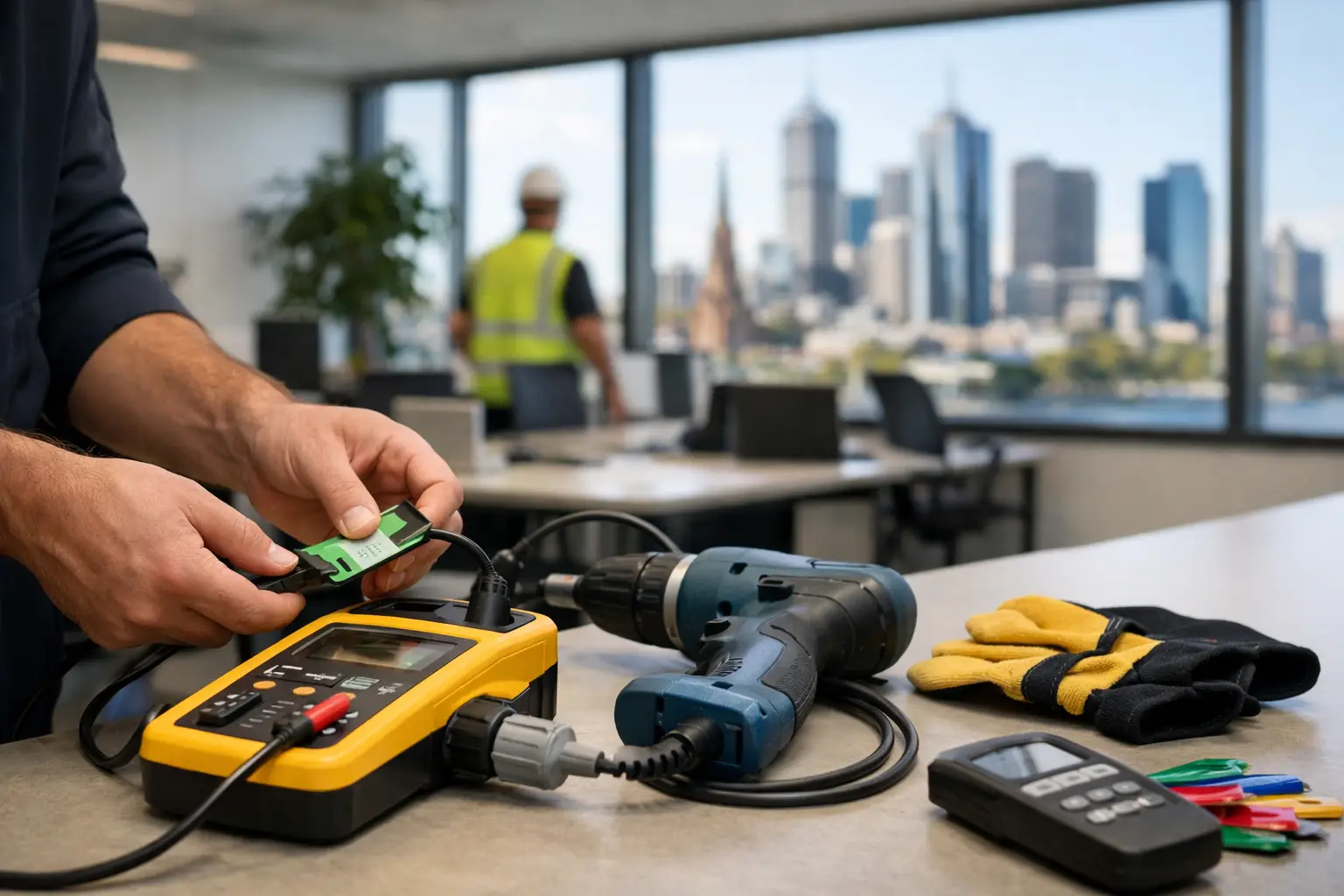
A damaged extension lead beside a workbench, a power tool used outdoors, or a portable appliance handled by the public can become a serious electrical risk long before its next scheduled service. That is why test and tag frequency should be based on how and where equipment is used, rather than a date chosen simply because it is convenient.
For Melbourne businesses, builders, facility managers and industrial operators, the right interval supports worker safety, reduces disruption and helps demonstrate that electrical risks are being managed properly. The wrong interval can mean either missed hazards or unnecessary testing costs. A practical program starts with understanding the risk level of each environment.
What test and tag frequency means
Test and tag involves inspecting and electrically testing portable electrical equipment, flexible leads and portable residual current devices (RCDs). The tag records that the item has been checked, identifies the tester and shows the next due date.
Frequency is the period between those checks. There is no single interval that suits every item in every workplace. A kettle in a low-traffic office does not face the same exposure as a grinder on a construction site, a lead dragged through a warehouse, or equipment used in a commercial kitchen.
Australian Standard AS/NZS 3760 provides a recognised framework for in-service safety inspection and testing of electrical equipment. It sets out recommended maximum intervals for different working environments, while Victorian workplaces must also meet their occupational health and safety duties. Site rules, client requirements, insurance conditions and the equipment manufacturer’s instructions may require a more frequent approach.
Recommended test and tag frequency by environment
The environment is generally the most useful starting point. Equipment subjected to movement, dust, moisture, heat, impact or frequent handling needs closer attention than equipment that remains in a protected office location.
Construction, demolition and major fit-outs
Portable electrical equipment, leads and portable RCDs used on construction and demolition sites are commonly tested every three months. These sites have a high level of risk due to changing conditions, outdoor work, trade activity and the likelihood of equipment being moved, dropped or damaged.
A construction site should also have clear controls for visually checking equipment before use and removing damaged items from service immediately. A current tag is not permission to keep using equipment with a split lead, loose plug, cracked casing or signs of overheating.
Factories, workshops and warehouses
A six-month interval is commonly applied to equipment used in factories, workshops and warehouses. This category includes many commercial and industrial settings where equipment is exposed to regular handling, forklifts, dust, vibration, storage damage or rough use.
That said, one warehouse is not necessarily like another. A mobile tool used around loading bays may warrant more frequent inspection than a desk-mounted item in a clean, restricted office area. Dividing a site into risk zones can produce a more useful schedule than treating every appliance the same.
Commercial kitchens, laboratories and similar work areas
Equipment in commercial kitchens, laboratories, health-related workspaces and other areas exposed to moisture, heat, cleaning chemicals or intensive daily use may need testing every six or 12 months, depending on the specific conditions. The key question is whether damage could occur between inspections and whether the equipment is handled by trained staff or a broad range of users.
Appliances with cords near wet areas deserve particular attention. Testing is only one control - suitable outlet locations, RCD protection, cleaning procedures and staff reporting all matter as well.
Public-use and hire equipment
Items available to the public, hired out, loaned between users or used in community settings are often tested every 12 months. These items may receive less careful handling because the user is not responsible for their long-term upkeep.
A 12-month interval may be appropriate for a controlled, well-maintained setting, but equipment that is frequently transported or used outdoors may need a shorter cycle. Keep usage patterns in view rather than relying on a label from a previous location.
Offices and low-risk areas
For low-risk office environments, equipment such as computers, monitors, printers and desk lamps may be tested at intervals of up to five years under the standard’s guidance. These spaces are usually dry, clean and supervised, with equipment that is rarely moved.
This does not mean office equipment can be ignored for five years. Staff should still report damage, and visual inspections should form part of normal workplace housekeeping. A frayed laptop charger or overloaded power board needs action now, not at the next programmed test date.
Residential properties
Routine test and tag programs are not generally required for ordinary household appliances in private homes. Homeowners should instead focus on safe use, sound condition, working safety switches and prompt repair or replacement of damaged appliances and leads.
Testing can still be worthwhile for equipment used in a home business, rental maintenance program, workshop or renovation setting. The appropriate approach depends on whether the area operates more like a workplace than a typical household.
How to decide the right interval for your site
The standard intervals are a strong guide, but a risk assessment should shape the final program. Start by identifying portable equipment and leads, then consider the conditions they face each day.
Equipment used outdoors, around water, in dusty areas, on uneven ground or near vehicle movements has a higher chance of cable or enclosure damage. Tools that are shared between crews, taken between sites or packed into utes are also more likely to be mishandled than equipment that stays in one controlled room.
Consider who uses the equipment. A tool handled by trained employees under supervision presents a different risk profile to public-use equipment or appliances used by casual staff. Also consider how quickly a fault could cause harm. High-use equipment connected to accessible outlets, particularly where leads run across floors or through busy work areas, should not be left on an extended testing cycle.
A useful register records the item description, asset number, location, test date, next due date and result. It should also record failures and replacements. This gives facility managers a clear view of upcoming work and makes it easier to identify recurring faults, such as leads damaged in one loading zone or power boards routinely overloaded in a particular office.
Testing does not replace daily checks
A common mistake is treating the test tag as the only safety control. Electrical testing confirms the condition of an item at a point in time. It cannot predict a lead being cut tomorrow or a plug being crushed under equipment after lunch.
Workers should carry out a quick visual check before using portable electrical equipment. They should look for damaged insulation, exposed conductors, loose fittings, cracked plugs, burn marks, bent pins and signs that a lead has been repaired improperly. If there is any doubt, the item should be isolated, labelled out of service and assessed by a competent person.
RCDs also need appropriate testing. Fixed safety switches in switchboards and portable RCDs have different testing requirements and methods. A competent electrical contractor can help set a schedule that covers both portable equipment and the wider electrical protection measures on site.
Avoid two costly scheduling errors
Testing everything every three months can feel like the safest option, but it may add cost and interrupt operations without improving risk control in a genuinely low-risk office. On the other hand, using the longest possible interval across a mixed-use facility can leave higher-risk equipment unchecked for too long.
The better approach is to separate equipment by environment and exposure. A business may have a five-year program for office equipment, six-monthly checks for warehouse leads and tools, and three-monthly checks for equipment used on active construction work. One site can legitimately have several frequencies.
For multi-site operators, consistency matters. Use the same asset identification method, keep records in one place and make sure equipment transferred between locations is tested according to the higher-risk environment where it will be used. This prevents a low-risk office tag being relied on after an item has been moved to a workshop or site shed.
When to review your program
Review test and tag frequency whenever the workplace changes. A warehouse expansion, new production line, refurbishment, change in shift patterns or move to outdoor work can alter the risk level. Review it after repeated failures too, as those failures often point to a handling, storage or layout issue rather than a testing problem alone.
A qualified electrical contractor can assess site conditions, test eligible equipment and help establish practical records without applying a one-size-fits-all schedule. For Melbourne workplaces with office, commercial and industrial areas under one roof, that tailored approach keeps the program manageable and aligned with actual use.
The most useful tag is not simply one with a future date on it. It is part of a routine where people recognise damage early, equipment is removed from service promptly and testing intervals match the work being done.