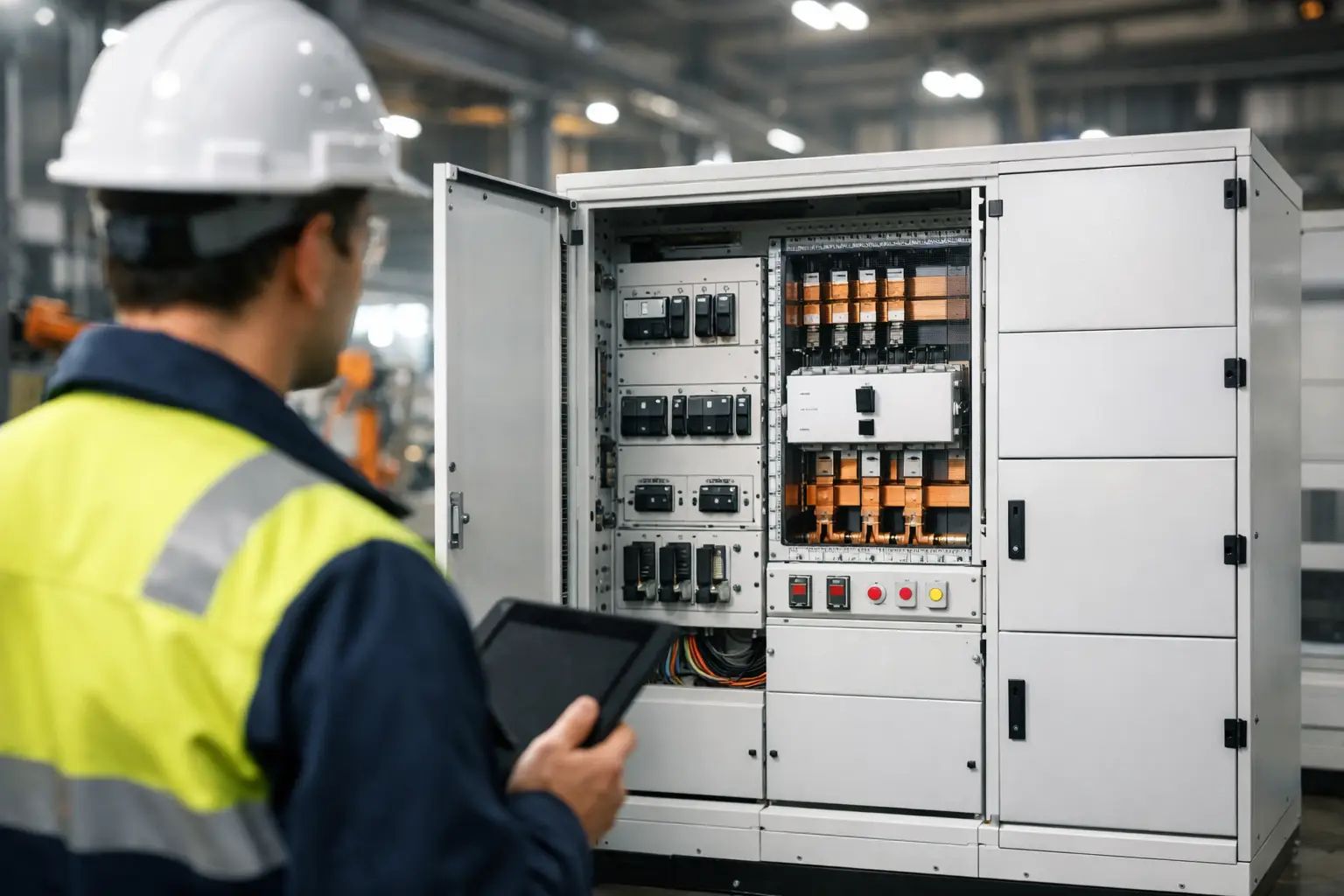
A switchboard can appear to be doing its job right up until a production change exposes its limits. In this factory switchboard upgrade case study, an ageing main switchboard had become a constraint on a Melbourne manufacturer’s safety, capacity and ability to schedule work without disruption.
The site had expanded progressively over many years. New machinery, extraction equipment, compressed-air loads and process controls had been added when required, often from existing distribution points. While this kept individual projects moving, the overall electrical installation was no longer suited to the way the factory operated.
This example is based on a typical industrial upgrade scenario. Site details have been generalised, but the planning approach reflects the work required to replace critical switchboard infrastructure in an active facility.
The problem: a switchboard built for a smaller factory
The original switchboard was serviceable, but it had limited spare capacity, crowded cable entries and circuit identification that no longer matched the site layout. Several additions had been completed across different periods, making fault-finding slower than it needed to be. A maintenance team could isolate known equipment, but tracing less familiar circuits was becoming a risk during breakdowns.
The factory manager also had a commercial problem. A planned production-line upgrade required additional electrical capacity, but connecting the new equipment to the existing board would have increased congestion and reduced flexibility for future changes. Continuing to extend an old board may have cost less upfront, yet it would have left the business with the same operational weaknesses.
The decision was made to replace and reorganise the main distribution arrangement rather than simply add more circuits. The objective was clear: improve electrical safety and maintainability, provide capacity for the new line, and complete the work with the shortest practical interruption to production.
Site assessment before the factory switchboard upgrade
A successful switchboard replacement starts well before shutdown day. The electrical contractor first needed a reliable picture of actual site demand, existing protection arrangements, cable routes, equipment criticality and the condition of downstream boards.
Load monitoring helped distinguish between connected load and genuine demand. This matters because nameplate ratings alone can overstate the capacity a factory needs, while measurements taken during a quiet shift can understate it. Readings were reviewed across normal operating periods, including the times when larger motors, process equipment and building services were running together.
The assessment also identified which equipment could be shut down, which circuits needed to remain available, and which loads required controlled restart procedures. This included lighting in work areas, security systems, communications equipment, office supply, selected refrigeration loads and essential safety systems.
Circuit tracing was a significant part of the preparation. Where labels were unclear, circuits were verified and recorded before the upgrade. This reduced uncertainty during the outage and produced a more useful as-built record for the facility team once the work was complete.
Designing for maintenance, not just connection
The replacement board was designed around how the factory would be operated and maintained. That meant allowing practical spare ways, clear segregation, appropriate fault protection and a logical circuit layout. Major process loads were grouped in a way that made isolation easier, while general services and future capacity were separated from production-critical circuits.
There is no single formula for spare capacity. A factory with a stable process and limited floor space may need a different allowance from a site that regularly introduces new machinery. In this case, the business had a realistic growth plan, so the design allowed for future circuits without oversizing the entire installation beyond what the site required.
The design also considered physical access. Switchboard rooms and electrical areas can become storage zones over time, restricting safe working space. The upgraded arrangement included a clearer access zone and improved labelling expectations so the board could be inspected and serviced properly.
Planning the shutdown around production
The shutdown was the project’s most sensitive stage. The factory could not accept an open-ended outage, so the work was programmed around a lower-production period. A detailed sequence was developed before site works began, covering isolation, disconnection, removal of the existing equipment, installation, termination, testing and controlled energisation.
Not every factory can stop completely. When continuous operations are involved, temporary supplies or staged changeovers may be possible, but they introduce additional design, cost and risk considerations. For this site, a single planned outage was the more practical option because the main work could be completed within an agreed weekend window.
Preparation made that window achievable. The new switchboard was built and checked before installation, cables were identified and prepared, and materials were confirmed before the outage began. The project team also made sure plant supervisors, maintenance personnel and key operators understood what would be unavailable and when.
A shutdown plan should account for more than the electrical board itself. Production machinery may need to be parked safely, computer-controlled equipment may require orderly shutdown, and some systems need a particular restart sequence. Addressing these details early avoids the common situation where power is restored but production cannot resume because a supporting system has not been reset or checked.
Installation, testing and controlled energisation
Once the site was isolated and proven de-energised, the old board was removed and the replacement installed. Existing cabling was assessed as each section was transferred. Where cables were suitable, they were terminated into the new arrangement; where condition, capacity or routing required attention, the issue was addressed before energisation rather than deferred.
The installation was completed with clear circuit schedules, durable labelling and updated documentation. These details are sometimes treated as finishing work, but they are central to safe fault response. During a production interruption, the difference between a clearly labelled circuit and an unidentified one can be hours of lost time.
Testing included verification of the installation, protective devices and control functions before the factory was brought back online. Energisation followed a staged sequence rather than restoring every load at once. This allowed the team to confirm normal operation, identify abnormal behaviour and coordinate with production staff as equipment was restarted.
The final return to service was not simply a matter of turning the main switch on. Process equipment, drives, controls and auxiliary services were checked in an agreed order. The contractor remained available during the initial operating period to address issues quickly and confirm the upgraded distribution system was performing as intended.
Results for the factory team
The immediate outcome was a safer, more organised switchboard with capacity for the planned production-line expansion. The facility team gained clearer circuit identification, improved access for maintenance and a documented electrical layout that reflected the site as it was actually operating.
Just as valuable was the reduction in operational uncertainty. Previously, an electrical fault could require time-consuming tracing through older additions. The new arrangement made isolation more straightforward and gave maintenance personnel a clearer starting point when responding to an issue.
The project also avoided the false economy of adding another layer to an already congested system. While a full switchboard upgrade required more planning and a scheduled outage, it gave the business room to grow without repeating the same problem at the next machinery installation.
For industrial operators, the right time to review a switchboard is usually before capacity, safety or reliability becomes an urgent issue. Signs such as recurring nuisance tripping, limited spare ways, hot connections, unclear labels, crowded enclosures or new equipment proposals warrant a proper assessment.
A well-planned upgrade is not just an electrical replacement. It is a production continuity project, a maintenance improvement and a practical investment in how the factory will operate next year and beyond. For Melbourne facilities planning expansion or managing ageing electrical infrastructure, early site assessment gives the business more options and far greater control over the outcome.