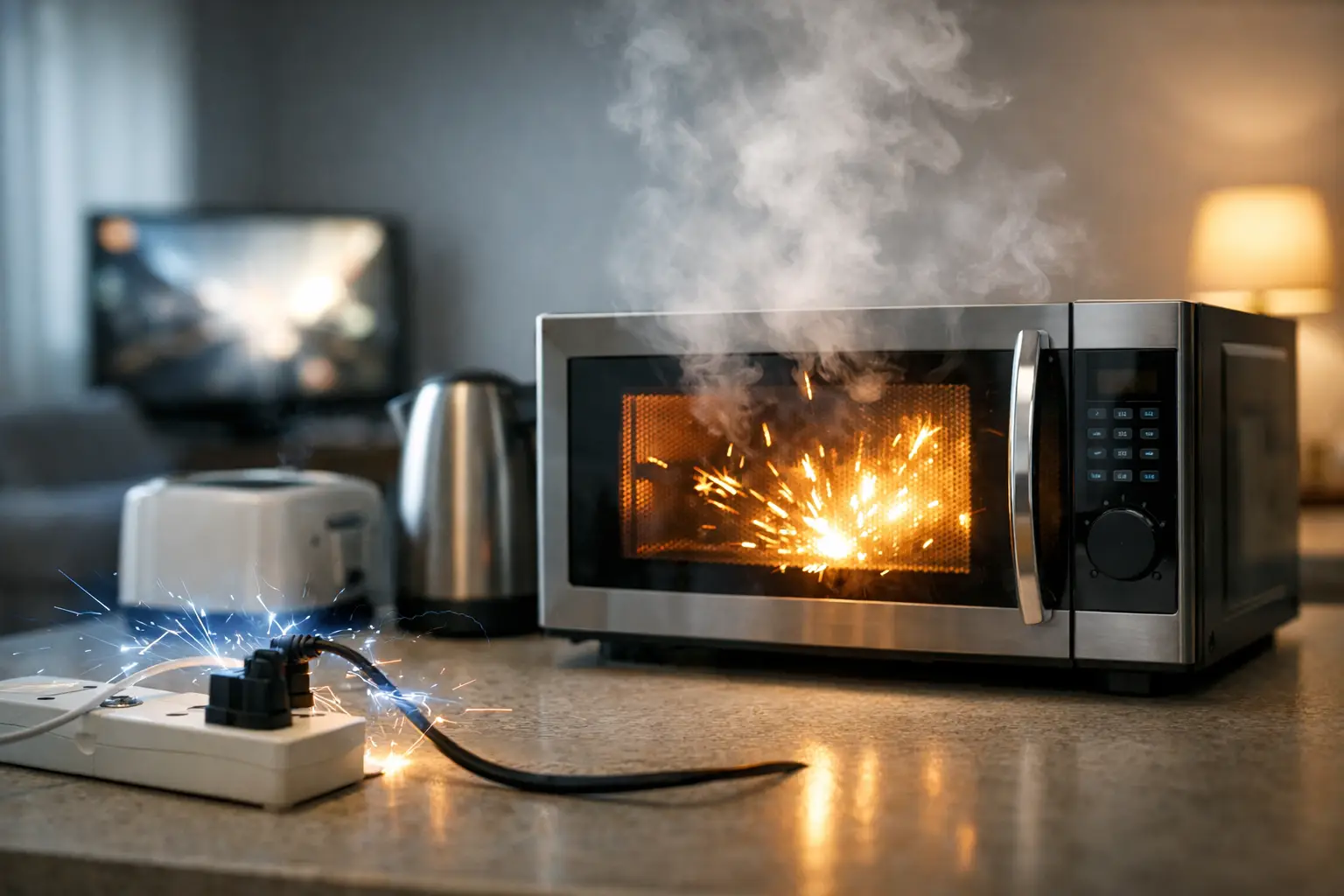
A television that will not turn on after a storm, a fridge with a failed control board, or a suddenly dead modem can all lead to the same question: are power surges damaging appliances in your property? They can be. A single major surge may cause immediate failure, while smaller and repeated surges can gradually weaken sensitive electronic components until an appliance stops working without an obvious event.
For Melbourne homes, businesses and industrial sites, the risk is not limited to lightning. Switching events on the electricity network, faults within a building and large equipment starting or stopping can all create voltage disturbances. Knowing where they come from helps you choose protection that suits the property rather than relying on one power board to solve every problem.
What a power surge does to an appliance
Australian electrical equipment is designed to operate at a nominal supply voltage of 230 volts. A power surge is a brief increase in voltage above the normal level. It may last only microseconds, but modern appliances contain circuit boards, sensors, power supplies and communications components that can be affected very quickly.
The result depends on the size and path of the surge. A severe event may burn out a power supply, damage a control board or trip protective devices. More commonly, smaller events create cumulative wear. Capacitors, semiconductors and insulation can deteriorate over time, reducing the service life of equipment that appears to have been working normally.
Older equipment with simple motors or mechanical controls can sometimes tolerate minor disturbances better than electronics-heavy appliances. However, even traditional appliances may now include electronic control modules. A refrigerator, washing machine, air conditioner, oven, security system or garage door opener can all contain components that are vulnerable to voltage spikes.
Are power surges damaging appliances or is it another fault?
Surge damage is not always easy to confirm after the fact. Appliances also fail because of age, moisture, overheating, worn components, poor connections or an unrelated internal defect. An electrician can investigate the electrical installation and identify issues such as loose terminations, circuit faults, inadequate earthing or signs that a protective device has operated.
A surge is more likely to be involved when several items fail or behave strangely around the same time, particularly after a storm or known supply interruption. Other warning signs include a device that repeatedly resets, a flickering display, an appliance that no longer charges correctly, or a burnt smell near a plug or power supply.
Do not keep using equipment that is hot, smells burnt, shows scorch marks or causes a circuit breaker or safety switch to trip. Switch it off if safe to do so, unplug it where practical, and arrange an assessment. Repeated tripping is not a nuisance to work around. It is a warning that needs to be investigated.
Common sources of surges in Victorian properties
Lightning is the most recognised cause, but direct strikes are relatively uncommon. Nearby lightning can still induce a substantial voltage spike through power, data, antenna or communications wiring.
In day-to-day conditions, surges may also be caused by electrical network switching, restoration of supply after an outage, damaged overhead lines or faults in the local distribution system. These events are outside the property, but their effects can enter through the main supply.
Inside the building, larger loads can create switching transients. Air conditioning compressors, pumps, lifts, welders, motors and some industrial machinery can affect the electrical environment when they start, stop or experience a fault. This does not mean the equipment is necessarily defective. It does mean circuit design, load management and protection should be considered on sites with significant motor loads.
Commercial and industrial properties have another consideration: equipment is often connected through data, communications and control cables as well as power circuits. A surge may travel along any conductive path. Protecting only a general power outlet may leave networked systems, access control equipment, CCTV, automation controls or telecommunications hardware exposed.
Protection works best in layers
There is no single device that guarantees an appliance will survive every electrical event. Effective protection uses layers, with each layer reducing the energy that reaches connected equipment.
Start at the switchboard
A licensed electrician can assess whether a surge protective device at the main switchboard is suitable for the installation. This is often the most useful first layer because it helps manage surges entering from the supply and can provide broad protection for circuits throughout the building.
The correct device and installation method depend on the switchboard, earthing arrangement, supply type, available fault current and the nature of the property. The device must be correctly rated, coordinated with other protective equipment and installed in accordance with applicable Australian standards. It is not a DIY job.
Surge protective devices are consumable components. They divert surge energy, and their protective capacity can reduce after significant events. Many have status indicators, but those indicators need to be checked as part of regular electrical maintenance. A device that has reached end of life may still look physically intact while no longer providing the intended protection.
Protect sensitive equipment close to the load
For high-value or sensitive appliances, point-of-use protection can provide an additional layer. Quality surge-protected power boards can be appropriate for televisions, computers, entertainment equipment and office workstations, provided they are used correctly and are not overloaded.
A power board is not a substitute for switchboard protection, proper earthing or safe electrical work. Avoid connecting one power board to another, using damaged leads, or treating a cheap board as proof that expensive equipment is protected. Check that it has suitable overload protection and that its surge protection indicator remains operational.
For critical systems, such as servers, medical-adjacent equipment, security infrastructure or production controls, the solution may involve dedicated surge protection, an uninterruptible power supply, voltage regulation or a site-specific power quality review. These measures address different problems. A UPS can provide short-term backup power, for example, but its surge capability and capacity must be assessed rather than assumed.
Practical steps after a storm or outage
After a major storm, supply interruption or suspected electrical event, check the property carefully before resetting anything repeatedly. Look for tripped circuit breakers or safety switches, but do not open the switchboard enclosure or attempt repairs yourself.
If only one appliance has stopped working, test it cautiously on a known working outlet only if there is no sign of damage and the manufacturer permits it. If several appliances or circuits are affected, leave them disconnected where possible and arrange professional assistance. Photograph visible damage and note the date, time and circumstances, particularly if an insurance claim may be required.
For businesses, keep a simple record of outages, equipment failures and production interruptions. Patterns matter. If the same control panel, workstation area or machinery circuit experiences repeated problems, a targeted electrical assessment can be more valuable than replacing failed equipment one item at a time.
When the issue is the installation, not the appliance
Some events that appear to be surges are linked to underlying installation faults. Loose or deteriorated connections can cause voltage fluctuations, heat and intermittent operation. In larger premises, unbalanced loads, undersized circuits, poor earthing or changes to machinery may affect supply stability.
Renovations and equipment upgrades are a good time to review protection. Adding a new ducted air conditioner, solar equipment, EV charging, commercial refrigeration or industrial machinery changes the demands on the electrical system. The existing switchboard and circuits may need assessment before new loads are connected.
For property managers and facility operators, scheduled electrical maintenance is particularly useful. It provides an opportunity to inspect switchboards, test relevant safety systems, identify heat damage or loose connections and confirm that surge protection remains serviceable. Preventative work is generally less disruptive than responding after a critical appliance or system fails.
A failed appliance is frustrating. A failed appliance that stops a household, tenant, shop floor or site operation is more than frustrating. If you have noticed repeat faults, storm-related damage or unexplained equipment failures, treat them as useful evidence and have the electrical system assessed before the next event tests it again.